|
|
|
Wasp
The
Wasp was a Universal Carrier fitted with a flamethrower.
Like Britain, Canada only began serious research into flamethrowers
after the start of the Second World War.
Flame throwers had been
used by the British on an experimental scale since 1940, but the
development of these weapons as standard equipment depended largely on
Canadian interest. Various experiments had been carried out by the
Canadian Army in the United Kingdom and the first production on a large
scale was in Canada.1
|

Canadian
War Museum display showing a Wasp in the markings of the PPCLI. (Wikipedia
Photo.) |
"Ronson" flame equipment was produced in large numbers, for mounting on
Universal Carriers. By the end of 1942, the first deliveries of a
production order of 1,000 had been completed. British requests to use 50
vehicles so-equipped in North Africa were rejected by the Canadian Army
overseas, fearing a loss of surprise should the weapons be utilized in
small numbers only. By the end of July 1943, 818 Ronson-equipped carriers
were in Europe (with the remainder of the order having been lost at
sea).2
A comparable British device, the Wasp Mark I, was considered by the
Canadians to be inferior to the Ronson, despite maintenance problems
with the latter weapon. The introduction of the Mark II Wasp, however,
led to an order by the Canadians of 500 Wasp kits from the British War
Office. Like the Ronson, the Wasp was fitted to a universal carrier, with
a flame nozzle in the front of the vehicle, and fuel tanks inside.
Canadian Wasp kits were done with a single external fuel tank rather
than dual internal tanks. This variant was known as the Mark IIC (for
Canada). The Ronsons in Canadian stores were used solely for training.
The Wasps were eventually used in infantry Carrier Platoons, and the
first vehicles were ready for action in June 1944. The initial scale of
issue was:
By the end of November 1944,
134 Wasp Mk II and 73 Wasp Mk IIC had been delivered (or 207 total of an established
strength throughout Canadian formations of First Canadian Army serving
in Northwest Europe of 192, and in keeping with the established policy
of First Canadian Army being equipped solely with the Canadian model.)3
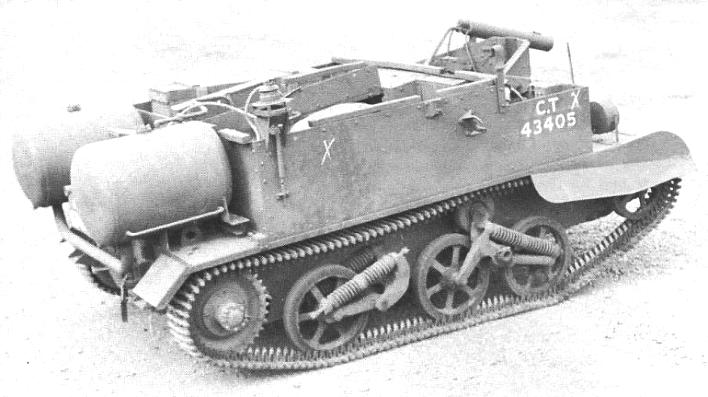
Canadian Ronson Carrier with external fuel
tanks. This type was only used for training purposes. (LAC photo)
The lightweight armour, open-topped design, and relatively low range of
the flame equipment on the Wasp (particularly vulnerability to mines and
anti-tank weapons) led to the development of the Badger.

Rifleman W.T. Orton and Rifleman H.H. Pennell of The Queen's Own
Rifles of Canada in a Wasp flamethrower carrier near Vaucelles,
France, 29 July 1944. Despite the summer heat, goggles. leather
gauntlets and wool balaclavas are worn as protection against
dust as well as subsidiary effects of the flame gun, visible at
right of the photo. The tactical sign (T10 in a diamond)
suggests the vehicle belongs to the No. 4 (Carrier) Platoon.
(LAC photo)
Notes
- Knight, Doug (editor) Tools of
the Trade: Equipping the Canadian Army (Service
Publications, Ottawa, ON, 2005) ISBN 1894581237
- Ibid, p.69
- Ibid, pp.70-74
|

