|
|
Postwar Formation
Insignia
1950s
At the start of the 1950s, two Canadian brigade
groups were created for service overseas. The 25th Canadian Infantry Brigade served
in Korea as part of the Commonwealth Division. The 27th Canadian Infantry Brigade
served with NATO forces in West Germany.
25th Brigade - Korea
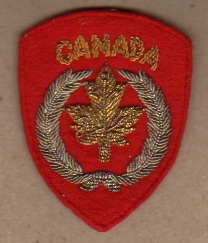
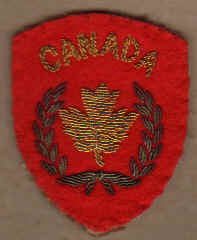
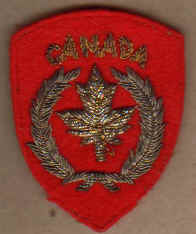
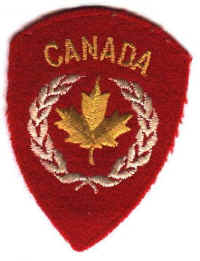
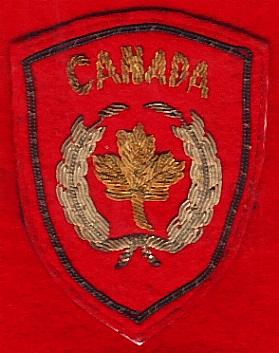
The 25th Brigade wore a red shield, with yellow
maple leaf surrounded by a white laurel wreath (similar to that found in the United
Nations flag). Issued in embroidery on a melton background, private purchase
versions were commonly found as well, purchased in Japan and made of higher quality
materials such as metal wire instead of thread. These uniforms were usually worn on
battledress by troops coming home to Canada from Asia.
This brigade patch was seen worn on both
sleeves, and sometimes worn alone on the right sleeve. After joining the
Commonwealth Division, Canadian troops in Korea wore the formation patch of that division
on the left sleeve, retaining the Canadian brigade patch on the left.
|
|
Standard issue 25th Brigade
patch. |
Japanese made wire bullion 25th Brigade badge |

Above and below: Examples from the collection of Bill Alexander
|
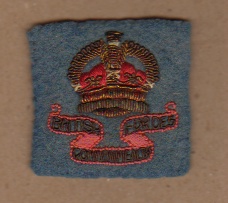
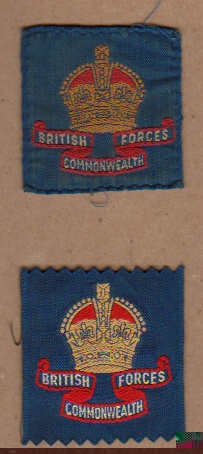
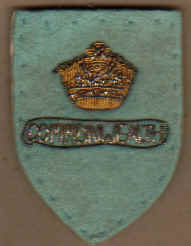
Although not a Canadian formation patch, two
types of Commonwealth patches were worn by Canadians serving in the Far East. Those
in the 25th Brigade wore the Commonwealth Division shield, usually on the left arm. The
Commonwealth Division shield, during the war, bore a King's Crown, but occupation troops
serving in Korea after the coronation of Queen Elizabeth II wore Queen's Crowns. The
"official" backing colour to the shield was UN Blue, but like French Grey, the
exact shade used in practice varied from badge to badge.
 |
 |
 |
 |
 |
 |
| A variety of patches
from the collection of Bill Alexander. At lower left is a printed badge with a
King's Crown, at lower middle is a silk badge printed with the Queen's Crown. |
Troops not serving directly in the Commonwealth
Division instead wore the square Commonwealth Forces patch. The examples below are
from the collection of Bill Alexander; badges at left have a Queen's Crown, in middle and
at right a King's Crown.
NATO Taskings
|
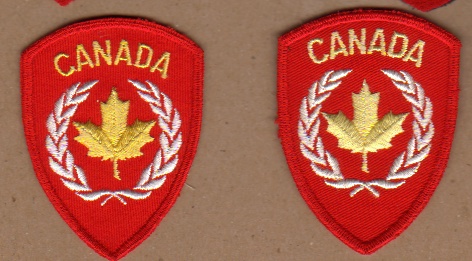
After the Korean war, and the disbandment of the
25th Brigade, the red shield continued to be used by Canadian soldiers as national
identification while on various UN duties around the world up into the 1970s. Later
versions are done from modern materials and have an embroidered edge to them.
Examples at right from the collection of Bill Alexander. |
 |
27th Brigade
The 27th Brigade was made up of three
battalions, each drawing its companies from several reserve regiments across Canada.
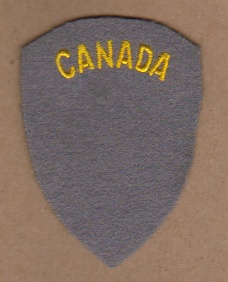
Brigade headquarters and support troops wore a plain grey patch, while the
three battalions were drawn from either line infantry, Rifle or Highland regiments in
Canada, and were a symbol designating these affiliations: a bayonet (line infantry), bugle
horn (Rifles) or Scottish thistle (Highland). These patches were worn on the right sleeve
of battledress, bush dress and service dress. The photo below, however, shows the
badge worn on the left sleeve of at least one officer.

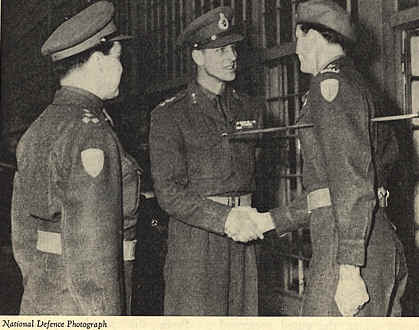
The Duke of Edinburgh is welcomed at the entrance of the Men's Canteen by Lt. Col.
G.M.C. Sprung, MC,
Officer Commanding of the 1st Canadian Infantry Battalion.
Photo courtesy Ed Storey
First Canadian Division
A 1st Canadian Division
Headquarters (later renamed First Division) was also authorized in April 1946, but
remained dormant until formally disbanded in July 1954. Simultaneously, however,
another "Headquarters, First Canadian Infantry Division" was authorized as part
of the Canadian Army Active Force, in October 1953. This, the first peace-time
Division in Canadian history, consisted of a brigade in Germany, one in Edmonton and one
at Valcartier. This Division was disbanded in April 1958. During its short
existence, it wore the same badge - the Old Red Patch - that the First Division had worn
between 1916 and 1918, and again from 1941-1945. This was a piece of red melton, 3
inches wide by 2 inches tall, worn on each sleeve. |

Artifact and image courtesy Bill
Alexander
|
1960s-80s
Force Mobile Command
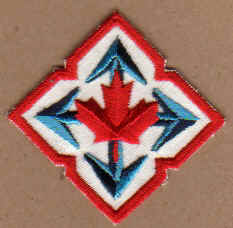
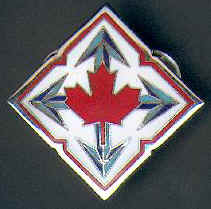
Command Badges were also introduced, as the
armed forces were reorganized into Commands. The Army became known as Force Mobile
Command and wore a maple leaf with four arrows protruding from it; at first, this badge
was worn on both sleeves of the battledress, and was later redesigned as a metal badge
worn on the right breast pocket of the CF Jacket and later DEU Jackets.
Canadian Mechanized Brigade
Groups
The reorganization of the Canadian Army into the
Canadian Forces, and the redesignation of various Canadian Mechanized Brigade Groups,
brought with it new insignia. These patches were worn on the new CF Green uniform
(and later, on the DEU jackets). Subdued versions of these insignia were also
introduced for the short-lived Garrison Dress Jacket.
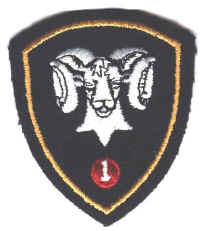
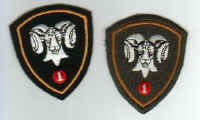
| 1
CMBG Based in Calgary |
 |
Examples from Bill Alexander
Click to enlarge
|
| 2
CMBG |
 |
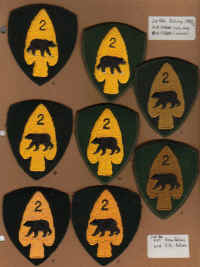
Examples from Bill Alexander
Click to enlarge
|
| 4
CMBG
Based in West Germany.
This badge has the NATO four pointed star
superimposed over the Canadian maple leaf. |
 |
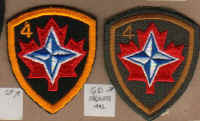
Examples from Bill Alexander
Click to enlarge
|
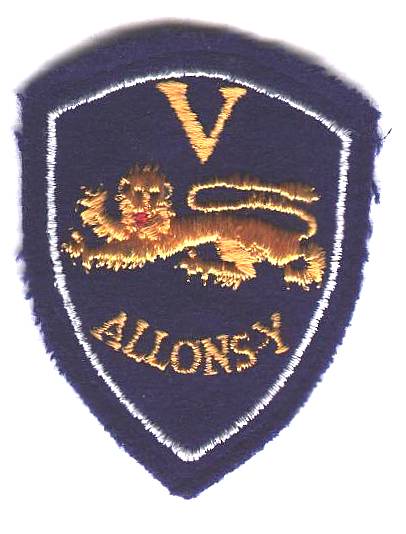
| 5
CMBG Made up of French-speaking
units. |
 |
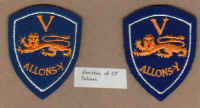
Examples from Bill Alexander
Click to enlarge
|
Special Service Force
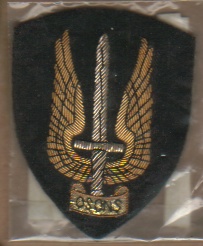
In 1977, the Canadian Airborne Regiment joined part of a new
organization called the Special Service Force (SSF), a brigade-sized formation created to
provide a small, highly mobile, general-purpose force that could be inserted quickly into
any national or international theatre of operations. The role of the Special Service Force
(SSF) had not changed significantly by 1992-3, when, according to DND, its role was
"to provide general-purpose, combat-ready land forces in accordance with assigned
tasks."
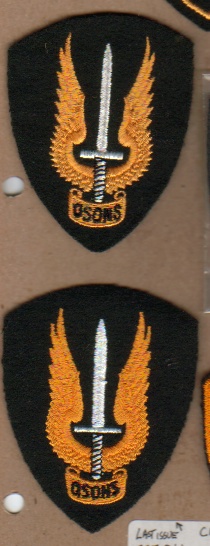
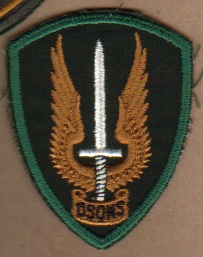
The brigade's insignia was a winged dagger, similar to that
worn by the British Special Air Service. Patches were made for the CF uniform
(including bullion versions) and in subdued colours for the Garrison Jacket and Jump
Smock, as well as in combat green. A browner version of the combat patch of
seemingly American construction has been spotted by Bill Alexander, but the provenance is
questionable.
 |
 |
 |
Artifacts
and images courtesy Bill Alexander
 |
Ace Mobile Force
|
The ACE Mobile Force was created in 1960 as a
small multinational force which could be sent at short notice to any threatened part of
Allied Command Europe. Its role was to demonstrate the solidarity of NATO its ability and
determination to resist all forms of aggression against any of its members.
Exercises designed to train and test the force were held each year in Northern and
Southern Europe. The AMF was deployed for the first time in a crisis role in January 1991,
when its air component was sent to south-east Turkey during the Gulf War, as a visible
demonstration of NATO's collective solidarity in the face of a potential threat to Allied
territory. The land component of the force, consisting of a brigade sized formation of
about 5,000 men, was composed of units assigned to it by eight NATO nations. |
 |

Above and below - these badges from the
collection of Bill Alexander show the two sizes (large and small) and types (dress and
subdued) of AMF badges. These are American manufactured; it is not believed a
Canadian version was ever produced.
 |
|
The original Force was formed by Belgium, West
Germany, the United Kingdom, and the United States of America, with Italy and Canada
contributing in 1963 and 1964 respectively. The contribution of each nation was a
light infantry battalion and support elements. The force was known as a NATO
"fire brigade" because of the rapidity with which it could be employed - with
leading elements on 72 hours notice to move, and the main body on seven days' notice, with
a theoretical deployment time of thirteen days. Luxembourg troops joined the AMF in
1969, followed by troops of The Netherlands in 1989. After significant political
events of that year, and the beginning of the end of the Cold War, the AMF expanded and
Spain became a contributor in 1992, followed by Norway in 1995. In 1996, Denmark,
Greece and Turkey sent forces to the AMF, followed by Portugal in 1997, and finally The
Czech Republic, Hungary and Poland all contributed troops under the auspices of their new
membership in NATO in 1999.
The Ace Mobile
Force was disbanded in 2002, in a parade at Campbell Barracks, Heidelberg, Germany.
The last commander of the Force was a Canadian, Major General W.M. Holmes, MBE, CD. |

Enamel pocket badge worn on the CF
Uniform, from the collection of Steve Forth, PPCLI. The 3rd Battalion PPCLI wore
these badges on the DEU while tasked as IRF (Immediate Reaction Force (Land) prior to
their deployment to Afghanistan in 2002. Steve Forth adds: "The badge originally was issued with a
leather holder to hang the badge from a button, however we simply wore the badge itself in
place of the LFC badge on the right breast pocket of the DEU.".
|
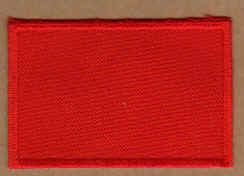
| First Canadian Division The First Canadian Division was reactivated in
1988, and once again, The Old Red Patch was worn with pride - on the Garrison Dress
Jacket, in modern materials with swiss embroidered embroidered edges. The
colour was not subdued for wear on Garrison Dress as other insignia was. On the DEU
Jacket, a melton patch - similar to that shown above - was worn. The patch was only
worn on the left sleeve, and the applicable brigade patch on the right sleeve. |
Artifact and image courtesy Bill
Alexander
|
1990s
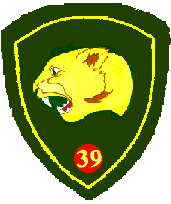
In the 1990s, the reserve forces in Canada were reorganized
from being grouped into Militia Areas into Brigades, and consequently, brigade patches
were issued for wear on the DEU. These brigades became active in 1997.
| Land
Force Atlantic Area |

36 Canadian
Brigade Group
(PEI - Nova Scotia) |

37 Canadian
Brigade Group
(New Brunswick) |
| Land
Force Quebec Area |

34 Canadian
Brigade Group |

35 Canadian
Brigade Group |
| Land Force Central
Area |

31 Canadian Brigade Group
(London) |

32 Canadian Brigade Group
(Toronto) |

33 Canadian Brigade Group
(Ottawa) |
|
Land
Force Western Area |
 |
 |
 |
38 Canadian Brigade Group
(Saskatchewan-Manitoba) |
39 Canadian Brigade Group
(British Columbia) |
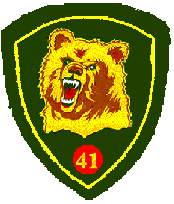
41 Canadian Brigade Group
(Alberta) |
The FMC badge was also finally replaced, as the land
component of the armed forces was once again christened the Army. A white shield
with a red maple leaf and crossed swords, reminiscent of early Army insignia, was adopted
as a metal pocket badge.
Various United
Nations and NATO Taskings
Over the last half of the 20th Century, Canadian soldiers
participated in almost every major United Nations peacekeeping mission; while each tasking
had its own insignia, the most common badge was the UN blue circle with the UN insignia (a
white globe). While not formation patches in the usual sense, a sampling (from the
collection of Bill Alexander) is given here, showing the variety - and also the degree of
continuity - of badges, from UNEF in the mid 1950s to the end of the 20th Century and
UNPROFOR.
Individual missions with both the UN and NATO have resulted
in the creation of a wide array of badges - both official and semi-official.
Multinational Force and
Observers
 |

MFO Photo
MFO Force Commander Major General Robert G Meating at left, wearing the MFO formation
patch, presenting a New Zealand Private the Multinational Force Silver Driving Award.
|
|
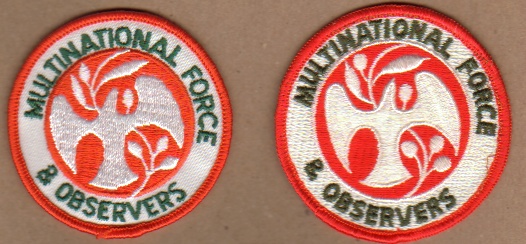
A white badge (symbolizing peace)
with the orange suggesting the bright coloured jump suits that civilian observers in the
MFO wore. These civilian observers operated as part of the US Sinai Field Mission in
1976, tasked with monitoring two major passages through the Sinai Peninsula between Egypt
and Israel. In 1982, the multi-national MFO incorporated this Sinai Field
Mission. The UN had refused to provide a peacekeeping mission to the area as
officially the two nations were at peace. Canadian troops have served on the MFO
since inception, mostly from logistics trades; between 1986 and 1988 Canada provided a
four-ship helicopter squadron of UH-1s to the mission.
The mission's four goals are:
- Operation of
checkpoints, reconnaissance patrols and observation posts along the international
boundary.
- Periodic verification of the implementation of the provisions of the Annex to the
Treaty of Peace, to be carried out not less than twice a month unless otherwise agreed to
by the parties.
- Additional verifications within 48 hours after receipt of a request from either party.
- Ensuring freedom of navigation through the Strait of Tiran.
|
Examples
from Bill Alexander - at top Canadian pattern, below international manufacture |
|
| Cambodian Mine Action Center
UNTAC Can contingent |
IFOR |
 |
 |
| Examples
from Bill Alexander |
Land Force Command
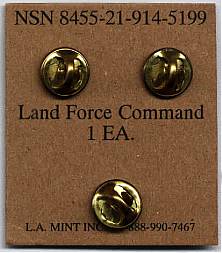
Force Mobile Command was redesignated Land Force
Command in the 1990s, and the distinctive FMC badge as worn on the right breast pocket of
the DEU jacket was replaced with the LFC badge as shown below, in enameled metal with
three pushpins on the back. It was worn in the same position as the FMC badge.
 |
 |
Steve
Forth Collection |
|