|
History |
|
Wars & Campaigns |
|
►Boer
War
►First
World War
►►Western
Front
►►►Trench
Warfare: 1914-1916
►►►Allied
Offensive: 1916
►►►Allied
Offensives: 1917
►►►German
Offensive: 1918
►►►Advance
to Victory: 1918
►►Siberia
►Second
World War
►►War
Against Japan
►►North
Africa
►►Italian
Campaign
►►►Sicily
►►►Southern
Italy
►►►The
Sangro and Moro
►►►Battles
of the FSSF
►►►Cassino
►►►Liri
Valley
►►►Advance
to Florence
►►►Gothic
Line
►►►Winter
Lines
►►North-West
Europe
►►►Normandy
►►►Southern
France
►►►Channel
Ports
►►►Scheldt
►►►Nijmegen
Salient
►►►Rhineland
►►►Final
Phase
►Korean
War
►Cold
War
►Gulf
War |
|
Operations |
|
|
|
Battle Honours |
|
Boer War
First World War
Western Front
Trench Warfare: 1914-1916
Allied Offensive: 1916
|
►Somme, 1916 |
1
Jul-18 Nov 16 |
|
►Albert |
.1-13
Jul 16 |
|
►Bazentin |
.14-17
Jul 16 |
|
►Pozieres |
.23
Jul-3 Sep 16 |
|
►Guillemont |
.3-6
Sep 16 |
|
►Ginchy |
.9
Sep 16 |
|
►Flers-Courcelette |
15-22
Sep 16 |
|
►Thiepval |
26-29
Sep 16 |
|
►Le Transloy |
.
1-18 Oct 16 |
Allied
Offensives: 1917
|
►Arras 1917 |
8
Apr-4 May 17 |
|
►Vimy, 1917 |
.9-14
Apr 17 |
|
►Arleux |
28-29 Apr 17 |
|
►Scarpe, 1917 |
.3-4
May17 |
|
►Hill 70 |
.15-25
Aug 17 |
|
►Messines, 1917 |
.7-14
Jun 17 |
|
►Ypres, 1917 |
..31
Jul-10 Nov 17 |
|
►Pilckem |
31
Jul-2 Aug 17 |
|
►Langemarck, 1917 |
.16-18
Aug 17 |
|
►Menin Road |
.20-25
Sep 17 |
|
►Polygon Wood |
26
Sep-3 Oct 17 |
|
►Broodseinde |
.4
Oct 17 |
|
►Poelcapelle |
.9
Oct 17 |
|
►Passchendaele |
.12
Oct 17 |
|
►Cambrai, 1917 |
20
Nov-3 Dec 17 |
German Offensive: 1918
|
►Somme, 1918 |
.21
Mar-5 Apr 18 |
|
►St. Quentin |
.21-23
Mar 18 |
|
►Bapaume, 1918 |
.24-25
Mar 18 |
|
►Rosieres |
.26-27
Mar 18 |
|
►Avre |
.4
Apr 18 |
|
►Lys |
.9-29
Apr 18 |
|
►Estaires |
.9-11
Apr 18 |
|
►Messines, 1918 |
.10-11
Apr 18 |
|
►Bailleul |
.13-15
Apr 18 |
|
►Kemmel |
.17-19
Apr 18 |
Advance to Victory: 1918
|
►Arras, 1918 |
.26
Aug-3 Sep 18 |
|
►Scarpe, 1918 |
26-30 Aug 18. |
|
►Drocourt-Queant |
.2-3
Sep 18 |
|
►Hindenburg Line |
.12
Sep-9 Oct 18 |
|
►Canal du Nord |
.27
Sep-2 Oct 18 |
|
►St. Quentin Canal |
.29
Sep-2 Oct 18 |
|
►Epehy |
3-5
Oct 18 |
|
►Cambrai, 1918 |
.8-9
Oct 18 |
|
►Valenciennes |
.1-2
Nov 18 |
|
►Sambre |
.4
Nov 18 |
|
►Pursuit to Mons |
.28 Sep-11Nov |
Second World War
War Against Japan
South-East Asia
Italian Campaign
Battle of Sicily
Southern
Italy
The Sangro and Moro
Battles of the FSSF
|
►Anzio |
22
Jan-22 May 44 |
|
►Rome |
.22
May-4 Jun 44 |
|
►Advance
|
.22
May-22 Jun 44 |
|
to the Tiber |
. |
|
►Monte Arrestino |
25
May 44 |
|
►Rocca Massima |
27
May 44 |
|
►Colle Ferro |
2
Jun 44 |
Cassino
|
►Cassino II |
11-18
May 44 |
|
►Gustav Line |
11-18
May 44 |
|
►Sant' Angelo in
|
13
May 44 |
|
Teodice |
. |
|
►Pignataro |
14-15 May 44 |
Liri Valley
|
►Hitler Line |
18-24 May 44 |
|
►Melfa Crossing |
24-25 May 44 |
|
►Torrice Crossroads |
30
May 44 |
Advance to Florence
Gothic Line
|
►Gothic Line |
25 Aug-22 Sep 44 |
|
►Monteciccardo |
27-28 Aug 44 |
|
►Point 204 (Pozzo Alto) |
31 Aug 44 |
|
►Borgo Santa Maria |
1 Sep 44 |
|
►Tomba di Pesaro |
1-2 Sep 44 |
Winter Lines
|
►Rimini Line |
14-21 Sep 44 |
|
►San Martino- |
14-18 Sep 44 |
|
San Lorenzo |
. |
|
►San Fortunato |
18-20 Sep 44 |
|
►Sant' Angelo |
11-15 Sep 44 |
|
in Salute |
. |
|
►Bulgaria Village |
13-14 Sep 44 |
|
►Pisciatello |
16-19 Sep 44 |
|
►Savio Bridgehead |
20-23
Sep 44 |
|
►Monte La Pieve |
13-19
Oct 44 |
|
►Monte Spaduro |
19-24 Oct 44 |
|
►Monte San Bartolo |
11-14
Nov 44 |
|
►Lamone Crossing |
2-13
Dec 44 |
|
►Capture of Ravenna |
3-4
Dec 44 |
|
►Naviglio Canal |
12-15 Dec 44 |
|
►Fosso Vecchio |
16-18 Dec 44 |
|
►Fosso Munio |
19-21 Dec 44 |
|
►Conventello- |
2-6 Jan 45 |
|
Comacchio |
. |
Northwest Europe
Battle of Normandy
|
►Quesnay Road |
10-11 Aug 44 |
|
►St. Lambert-sur- |
19-22 Aug 44 |
Southern France
Channel Ports
The Scheldt
Nijmegen Salient
Rhineland
|
►The
Reichswald |
8-13 Feb 45 |
|
►Waal
Flats |
8-15 Feb 45 |
|
►Moyland
Wood |
14-21 Feb 45 |
|
►Goch-Calcar
Road |
19-21 Feb 45 |
|
►The
Hochwald |
26
Feb- |
| . |
4
Mar 45 |
|
►Veen |
6-10 Mar 45 |
|
►Xanten |
8-9
Mar 45 |
Final Phase
|
►The
Rhine |
23
Mar-1 Apr 45 |
|
►Emmerich-Hoch
|
28
Mar-1 Apr 45 |
|
Elten |
. |
Korean War
|
|
Domestic Missions |
|
►FLQ
Crisis |
|
International
Missions |
|
►ICCS
Vietnam 1973
►MFO
Sinai 1986- |
|
Peacekeeping |
|
►UNTEA |
W. N. Guinea 1963-1964 |
|
►ONUCA |
C. America
1989-1992 |
|
►UNTAC |
Cambodia
1992-1993 |
|
►UNMOP |
Prevlaka
1996-2001 |
|
|
Exercises |
|
Authie
|
Authie
was a Battle Honour granted to units participating in battles
following D-Day during the Battle
of Normandy, the first phase of the North-West Europe campaign of
the Second World War.
Background
D-Day on 6 June had
left the three British and Canadian beachheads reasonably secure,
thanks to a slow German response and lower than anticipated
casualties, yet the gap between the British 3rd Division and the 3rd
Canadian Division was troublesome. Nonetheless, on D+1, June
7th, wheels were already in motion for energetic armoured
counterattacks on the Commonwealth beaches by the 12th SS Panzer
Division and 21st Panzer Division. The Canadians, for their part,
were concerned with making an all-out push for the final D-Day
objective line, code-named OAK, that had not been achieved the
previous day. For the Canadians, this was represented in reality by
the railway line running parallel to the Caen-Bayeux road, and the
airfield at Carpiquet. The 7th Brigade made good progress on their
objectives on the morning of June 7th, one battalion becoming the
first unit of the entire 2nd British Army to seize their D-Day
objectives - though the fighting would turn fierce later in the day.
The 9th Brigade had a harder time of it beginning in the early hours
of D+1.1 |
|

Early Actions on D+1
The North Nova Scotia
Highlanders and Le Régiment de la Chaudière came under attack by
half-tracked infantry at 0200 on 7 June, apparently by troops belonging
to 21 Panzer Division, the Chauds exchanging an entire platoon for
several prisoners of the 192nd Panzer Grenadier Battalion.2
The 9th Brigade was apparently not deterred from its task of moving on
its OAK objectives.
Advance on Authie
The War Diary of the 27th
Canadian Armoured Regiment (The Sherbrooke Fusilier Regiment) noted:
At first light the
unit moved off from the high ground at La Mare with the North Nova
Scotia Highlanders. They moved south towards Villons Les Buissons in
the same order as yesterday. A Squadron under Major E.W.L. Arnold on
the right, B Squadron under Major G.S. Mahon on the left and C
Squadron under Major V.O. Walsh in the centre. RHQ tanks with the
Commanding Officer LtCol M.B.K, Gordon moved along the centre line
in front of C Squadron.3
The reconnaissance troop,
equipped with Stuart tanks, led the column, followed by "C" Company of
the North Novas riding on Universal Carriers. Behind them came a platoon
of Vickers machine guns from the Cameron Highlanders of Ottawa, a troop
of tank-destroyers of the divisional anti-tank regiment, two assault
sections of pioneers, and four of the battalion anti-tank gun platoon's
6-pounder anti-tank guns. Three companies of North Novas followed
behind, riding on the tanks of the Sherbrooke Fusilier Regiment. The
initial advance is summed up by the official history in three sentences,
noting only that opposition was slight, stiffening as the forces
approached Buron, which was occupied by 11:50, and that two 8.8cm guns
were reportedly knocked out before that time.4
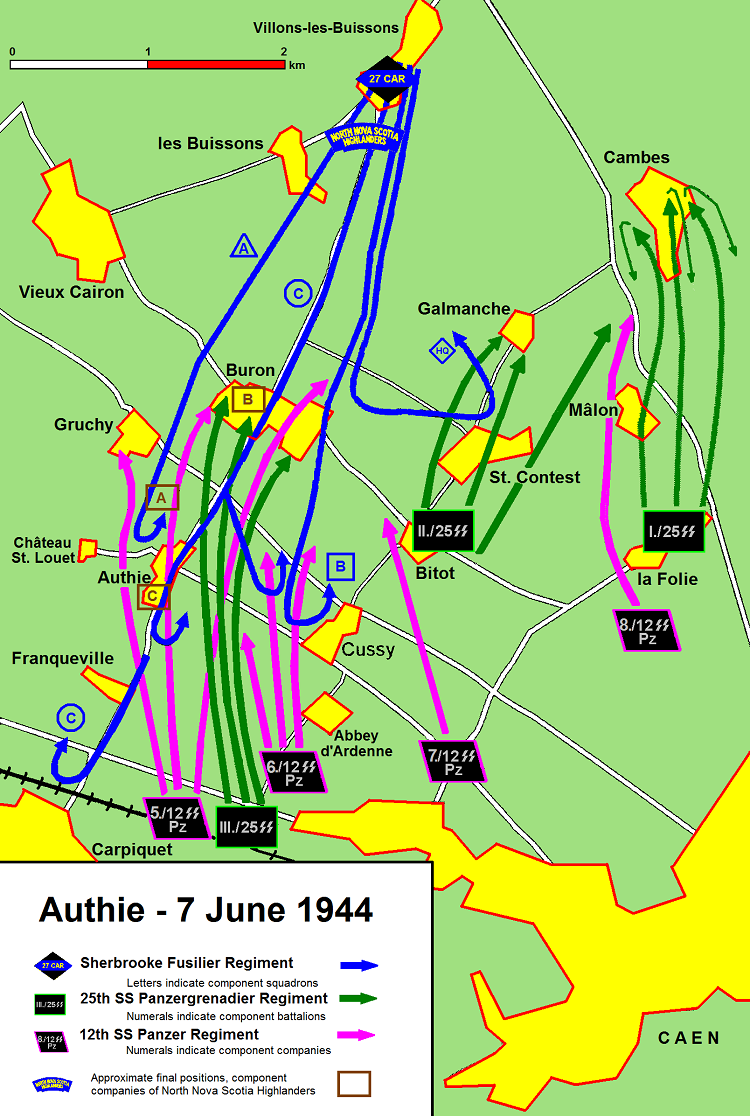
As "C" Company searched Buron, "B" Company headed for Authie, their
tanks deploying midway between the two villages and engaging targets in
the latter. Mortar fire from St. Contest caused trouble for the
Canadians by this time; "C" Company passed two platoons in carriers
through "B" Company but took Authie after a "sharp skirmish" and dug in
at the south edge of the village, which came under intense shelling and
mortar fire. The 9th Brigade headquarters was informed of the capture of
Authie at 1300, and at 1310 informed 3rd Canadian Division HQ that enemy
armour was 800 yards east of Authie. By this time the reconnaissance
troop of the Sherbrooke Fusilier Regiment was reported in Franqueville
and "A" Company of the North Novas had passed to the west of Buron and
were also approaching Authie, but had dismounted from their tanks and
were advancing on foot without support and were taking heavy fire from
the west.5
Artillery support was not available as the
14th Field Regiment, in support of the 9th Brigade, was in the process
of changing location and the 19th Field Regiment, also available to the
sector, was firing in support of the North Shore (New Brunswick)
Regiment. Radio communications to naval gunfire were temporarily also
lost, but after contact was re-established, support was able to be
brought down with effect. In the meantime, the advance troops of the
brigade were left with exposed flanks and no support. The commanding
officer of the Highlanders, Lieutenant Colonel Petch, ordered "A"
Company to dig-in south-east of Gruchy, and for "B" Company to withdraw
from Authie and join them and create a "battalion fortress" north of
Authie. Heavy fire, however, pinned "B" Company in Buron and two
platoons of "C" Company were struck by a German counter-attack in Authie.
Hitler Youth
Counter-Attack
The commander of the 25th
SS Panzergrenadier Regiment, a component of the 12th SS Panzer Division
(Hitlerjugend), made a personal reconnaissance from the chapel of
the Abbey d'Ardenne, the medieval building serving as divisional
headquarters, and upon seeing the tanks of the Sherbrooke Fusilier
Regiment fanning out over the countryside (in fact, his own vehicle had
been fired on not long before, likely by a Sherbrooke Fusilier), he
issued deployment orders for the 2nd Battalion (equipped with PzKpfw IV
vehicles) of the 12th SS Panzer Regiment and the troops of his own 25th
Panzergrenadier Regiment.
After a second
reconnaissance from the chapel, he pushed up his attack two hours, and
ordered the three infantry companies of the 3rd Battalion to strike at
Authie and Buron with the 5th and 6th Panzer Companies. with Authie
secured, the 2nd Battalion was to advance from Bitot. The 3rd Battalion
commenced its attack at 1400.
At 1410, "B" Squadron of
the Sherbrooke Fusilier Regiment made contact with the 6th Panzer
Company east of Authie, and soon after, "A" Squadron to the west engaged
the 5th Panzer Company. "A" Squadron lost two Shermans within minutes;
Lieutenant Fitzpatrick moved his tank - the sole survivor of his troop -
to a firing position south of Authie to find his breech mechanism had
failed. When his tank was hit, two men were killed and a third wounded.
Lieutenant Windsor's troop was also forced to withdraw, though his tank
was also hit and his crew baled out, to be taken prisoner.
"B" Squadron, with eleven
tanks, engaged the 6th Company at several hundred yards range and
exchanged fire successfully, knocking out several German tanks and
forcing the other to withdraw. Attempting to advance, they ran into
anti-tank obstacles and were bogged down, though they were able to
extricate themselves after a few anxious minutes of exposure to
anti-tank and artillery fire. The five survivors withdrew to Gruchy.6
The infantry attack on
Authie went in behind the tanks, in a "V" formation, two companies "up"
and one in reserve. The Canadian official history states succinctly that
platoons of the North Nova Scotia Highlanders, with some troops of the
Cameron Highlanders of Ottawa and some tanks, "fought hard (in and
around Authie) but were overrun; only a few men got away."7
A history
of the 12th SS is also succinct:
The Shermans of
the Sherbrooke Fusiliers suffered heavy losses. But the Sherman,
which also carried a 75mm gun, was well-matched with its adversary,
and immediately the first Panzer IVs erupted in smoke and flame.
Others were set ablaze by Canadian anti-tank guns firing incendiary
shells (Phosphorgranaten.) With barely seconds to escape some of the
SS tankmen managed to tumble clear of the flaming hulls; those less
fortunate burned in place. The survivors, burned and disfigured,
stumbled back towards the rear.
The remaining
German armor swept on towards Authie, accompanied by the infantry
advancing in a deep, narrow formation through the tall grain. Moving
swiftly, the Germans took their first prisoners and dispatched them
into captivity. Overhead, clouds of enemy fighter bombers winged
past but did not disturb the attackers, for the aircraft were on
their way to contest targets farther inland. While the two lead
infantry companies and most of the tanks bypassed Authie on either
side, the third company and a handful of Panzer IVs stormed the
village. A Canadian captain, taking the Browning automatics from
several knocked-out Shermans, hastily organized its defence. But his
small force was rapidly overrun, and no one escaped to record this
gallant action. The SS crushed the platoons of the North Nova Scotia
Highlanders in and around Authie; with the village secured, they
pushed on towards Gruchy and Buron...8
Nine tanks supported the
9th Company in their assault on Authie; facing them were two platoons of
"C" Company of the North Novas under Captain Fraser, and Lieutenant
Sutherland's platoon of "A" Company. They had only one tank left in
support, a 17-pounder armed Sherman, and no anti-tank weapons of their
own. They nonetheless decided they would make a stand; and positioned
themselves along a hedge in an orchard and salvaged Browning machine
guns from knocked out Sherman tanks.
The Germans attacked
after a preparatory barrage; they advanced to within a few hundred
yards, and a firefight ensued. During the running battle, the commander
of No. 13 Platoon retrieved a Universal Carrier from inside the village
belonging to the Camerons, upon which was mounted a Vickers machine gun.
SS troops of the 9th Company had infiltrated by now into the orchard and
were firing into the Canadian positions at close range; the carrier was
deployed to the west end of the orchard where it duelled with the
infiltrators. Their radio damaged, the infantry tried to get a message
for reinforcements through to the Sherbrooke's HQ via the tank radio,
for relay to the CO of the North Novas via Brigade Headquarters. The
message was received, and pleas to hang on were sent back via the same
route. Reassured, the troops kept fighting, but it was for nought, as no
reinforcements were ever sent.
The Canadians held out
for almost 60 minutes, against successive assaults, first mass assaults,
then small groups. The 11th Company worked its way to the northern part
of Authie to flank "A" Company. Lieutenant Veness, who had manned the MG
carrier, was ordered to escape with anyone who could still make it while
the wounded in the orchard stayed behind to provide cover. Between 20
and 30 men made it into Authie and the farmland beyond, while Captain
Fraser and the wounded made their last stand in the orchard, finally
succumbing in close quarters combat just after 1600.9
War Crimes
What happened next became
a matter of great controversy, though the facts themselves are not
disputed:
German losses
among the young soldiers and their battle-hardened NCOs had been
heavy. A few, seeking revenge, turned on their Canadian prisoners.10
In all, 156 Canadian soldiers were murdered
in cold blood in Normandy (about a score at Authie alone), in a spree
beginning with those troops captured at Authie on June 7th, and ending
ten days later. The perpetrators were all members of the 12th SS Panzer
Division; the victims all members of the 3rd Canadian Infantry Division.
The matter has been controversial in that few of the perpetrators were
ever brought to justice for their crimes.
Aftermath
Buron itself was hotly
contested, and eventually lost late in the afternoon, and then retaken
once again by the Highlanders and surviving tanks of the Sherbrooke
Fusilier Regiment when heavy artillery support was once again available.
However, at dusk, advance units fell back to Les Buissons, and the other
battalions of the 9th Brigade joined them there to create a "Brigade
Fortress." They would remain there for a month, until Operation
CHARNWOOD in July, when the brigade moved forward over the same ground
once again to attack Buron four weeks later.
The losses had been
heavy, with the North Novas suffering 242 casualties, 84 fatal, and 128
being captured. A footnote to the latter is that three prisoners,
including Lieutenant Veness, escaped from captivity while in transit to
Germany, made contact with the French Maquis, and eventually returned to
England and rejoined the Army (making the comment quoted above by the
German divisional historian about no one escaping to tell the story not
only inaccurate but ironic). The Sherbrooke Fusilier Regiment lost 21
Sherman tanks, with 7 more damaged, and had 60 personnel casualties,
including 26 killed. The Canadians estimated 31 destroyed enemy tanks,
while Kurt Meyer estimated losses of tanks at six.
The Canadian official
historian concluded that:
The 9th Canadian
Infantry Brigade Group had fought its first battle with courage and
spirit, but somewhat clumsily. Encountering an unusually efficient
German force of about its own strength, it had come off second-best.
Its advanced guard had been caught off balance and defeated in
detail. The German blow had been well coordinated; it seems evident
that tanks, infantry and artillery all played their parts
effectively in close cooperation with one another. This sort of
cooperation was less evident on our side, at least until near the
end of the day.11
However, historians have
come to reassess the abilities of the 12th SS in these opening days of
the campaign.12 There were other battles fought around Authie
over the course of the next three days, between the 3rd Canadian
Division and the 12th SS Panzer Division. The Canadian Army's official
historian went on to note that the "German counter-attack was not made
in sufficient strength to have much effect upon the bridgehead battle as
a whole. Meyer's force was too small to achieve a great deal,
particularly in the reduced state which it must have been in after the
fierce fighting around Authie and Buron. He was in fact fought to a
standstill; but before this took place he had inflicted a severe local
reverse on the 9th Brigade."13
Battle Honour
The following Canadian units were awarded the Battle Honour "Authie"
for participation in these actions:
 2nd Canadian Armoured Brigade
 9th Canadian Infantry Brigade
Notes
-
McKay, A. Donald Gaudeamus Igitur
"Therefore Rejoice" (Bunker to Bunker Books,
Calgary, AB, 2005) ISBN 1894255534 p.136
-
Stacey, C.P. Official History of
the Canadian Army in the Second World War: Volume III: The Victory
Campaign: The Operations in North-west Europe 1944-45
(Queen's Printer, Ottawa, ON, 1960) p.126
-
Gilbert, John Bloody Buron:
Canada's D-Day +1 (Gargunnock Books, Ripley, Woking, UK,
2004) ISBN 0-9735614-1-6 p.86
-
Stacey, Ibid, p.128
-
Ibid, p.128
-
Margolian, Howard Conduct
Unbecoming: The Story of the Murder of Canadian Prisoners of War in
Normandy (University of Toronto Press, Toronto, ON, 1998)
ISBN 0-8020-4213-9 pp.49-52
-
Stacey, Ibid, p.131
-
Luther, Craig W.H. Blood and
Honor: The History of the 12th SS Panzer Division "Hitler Youth",
1943-1945 (R. James Bender Publishing, San Jose, CA, 1987)
ISBN 0-912138-38-6 pp.135-137
-
Margolian, Ibid, pp.54-56
-
Foster, Tony Meeting of
Generals (Methuen Publications, Agincourt, ON, 1986) ISBN
0-458-80520-3 p.316
-
Stacey, Ibid, p.133
-
Haller, Oliver "The Defeat of the 12th SS 7-10 June
1944" Canadian Military History
Quarterly, Volume 3, Issue 1
-
Stacey, Ibid, p.133
|



