|
|
Bailey Bridge
The Bailey Bridge was a
British-designed portable pre-fabricated truss bridge, designed for use by
military engineering units to bridge gaps up to 200 feet wide. The bridges
were introduced into service in 1942 and first used by Allied units in
combat beginning in 1943 during the Second World War. The design was
unique in that:
-
Construction required no
tools or heavy equipment.
-
Bridge components were
small enough to be carried in trucks and even man portable over short
distances.
-
The bridge was strong
enough to bear the weight of vehicles up to 70 tons (Bridge
Classification 70).
History
A civil servant in the
British War Office named Donald Bailey is credited with the design. After
presenting one of the model bridges he built as a hobby to his bosses, it
was felt that there was merit in the design. The bridge was first employed
in Sicily in 1943, and the very first Bailey Bridge built under fire was
at Leonforte in Jul. (The website of the Royal Engineers states that the
first bridge built "in contact with the enemy" was in North Africa in November
1942.) A total of 38 Bailey bridges were built by the Allies during the
Battle of Sicily in addition to 20 Small Box Girder Bridges (SBG). In
Italy, 2,832 Bailey Bridges were constructed by the Allies. The Bailey
could also be used in conjunction with pontoons, and 19 such bridges were
built in Italy. The longest Bailey Bridge constructed in Italy was 1,126
feet long, and built over the Sangro in December 1943.
By the time of D-Day in
Normandy, production had been increased and the US were also building
bridge components under license. Bailey was knighted, and the bridge
design would soldier on into the 21st Century.
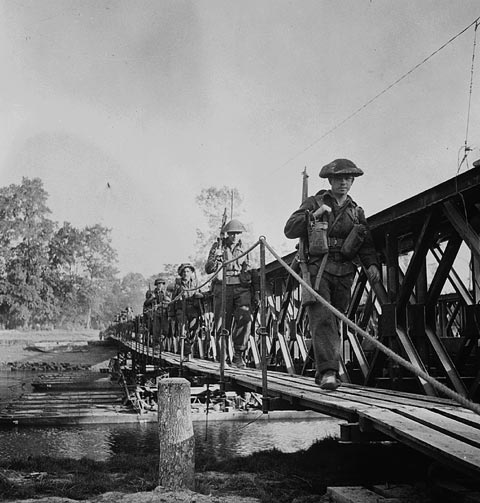 |
| Men of The Stormont, Dundas and
Glengarry Highlanders cross a small pathway built on the side of a
Bailey Bridge in Normandy, July 1944. LAC Photo. |

The North Nova Scotia Highlanders
cross London Bridge, a Bailey bridge across the Odon River south
of Caen, France, on 18 July 1944.
Design Features
-
Modular design: bridges
could be built to varying lengths and strengths as needed (doubling or
tripling side panels and roadbeds, for example, was possible)
-
No heavy equipment
needed: almost all previous types of military bridge required cranes for
assembly, the Bailey did not.
-
Interchangeable parts:
despite being produced by different factories, the parts were
interchangeable
-
Lightweight - each part
could be moved by a small group of men
Components
The Bailey Bridge consisted
of basic parts:
-
The deck of the bridge
consisted of a number of 19-foot wide transoms that ran across the
bridge.
-
10 foot long stringers
ran between the transoms, forming a square.
-
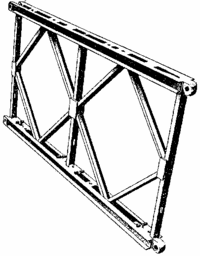
The bridge's strength was
provided by side panels (as at right), which were 10 feet long
cross-braced beams placed vertically above the stringers, and clamped to
the stringers to hold them in place.
-
Ribands were placed on
top of the completed structural frame, and wood planking placed on top
of the ribands to provide a roadbed. (Wood planking was replaced by
steel later in the war, which was less susceptible to damage from metal
vehicle tracks.)
Each unit constructed of
these components created a single 10 foot long section of bridge, with a
12 foot wide roadbed.
Bridges
After one section was
complete it was typically pushed forward over rollers on the bridgehead,
and another section built behind it. The two were then connected together
with pins pounded into holes in the corners of the panels.
For added strength several
panels (and transoms) could be bolted on either side of the bridge, up to
three. Another solution was to stack the panels vertically. With three
panels across and two high, the Bailey Bridge could support tanks over a
200 foot span.
Another feature of the
Bailey bridge was its ability to be "launched" from one side of a gap. In
this system the front-most portion of the bridge was angled up with wedges
into a launching nose and most of the bridge was left without the roadbed
and ribands. The bridge was then placed on rollers and simply pushed
across the gap, using manpower or a truck or tracked vehicle, at which
point the roller was removed with the help of jacks and the ribands and
roadbed installed, along with any additional panels and transoms that were
necessary.
 |
| Bailey Bridge erected in Surinam in
1976; the tripling of the side panels can be seen, as can the wooden
planking and ribands visible through the (deteriorating) planks.
Wikipedia photo. |

Sappers of the Royal Canadian Engineers lay
decking on Blackfriars Bridge over the Rhine at, Rees, Germany, on 30
March 1945.
Library and Archives Canada photo.
Colour
Bridge were painted in a
drab colour; in May 1944 First Canadian Army operational orders stated
that while vehicles in the Canadian Army would generally be painted olive
drab (see Vehicle Markings for more information), Bailey bridging
equipment would remain painted in "standard Camouflage Colour No. 2 to
distinguish them from American made Bailey bridges."
|