 21st
Army Group
21st
Army Group
The 21st Army Group was the
senior British formation in Northwest Europe in 1944-45. All ground forces
landing on D-Day in Normandy on 6 June 1944 were under the command of 21st
Army Group.
Senior Allied Formations in
Northwest Europe
Supreme Headquarters Allied Expeditionary
Force (SHAEF)
General Dwight D. Eisenhower
(General of the Army from 20 Dec 1944)
|
21st Army Group |
|
12th Army Group |
|
6th Army Group |
| 6 June 1944 |
|
12 July 1944 |
|
1 August 1944 |
General Bernard L. Montgomery
(Field Marshal from 1 Sep 1944)
|
|
General Omar N. Bradley
|
|
General Jacob L. Devers
|
|
British 2nd Army
6 June 1944 - VE Day |
|
|
|
|
|
U.S. 1st Army
6 June 1944 - 1 Aug 1944 |
|
U.S. 1st Army
1 Aug 1944 - VE Day |
|
|
|
1st Canadian Army
Aug 1944 - VE Day |
|
|
|
|
| |
|
U.S. 3rd Army
1 Aug 1944 - VE Day |
|
|
|
U.S. 9th Army
20 Dec 1944 - 4 Apr 1945 |
|
U.S. 9th Army
5 Sep 1944 - 20 Dec 1944
&
4 Apr 1945 - VE Day |
|
|
| |
|
|
|
U.S. 7th Army
1 Aug 1944 - VE Day |
| |
|
|
|
French 1st Army
1 Aug 1944 - VE Day |
Twenty-First Army Group, like
all army groups, was composed of General Headquarters (GHQ) Troops, its
component Armies, Lines of Communication (LofC) Troops, and base
installations. After the German surrender, 21st Army Group was converted
into the headquarters for the British zone of occupation in West Germany,
being redesignated the British Army of the Rhine on 25 August 1945.
 Insignia
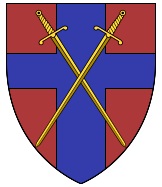
The Army Group adopted its insignia in September 1943, a blue cross on a red
background with two gold crusader's swords “in saltire” (diagonally
crossed). A shield without swords was used as the insignia of 21st Army
Group General Headquarters and Line of Communication Troops. Headquarters,
Line of Communication, 21st Army Group used a yellow shield with blue cross
as its formation insignia, as did some units directly assigned such as the
Chief Engineers (Works). The crusader's cross insignia was a common theme in
British military insignia, consistent with the notion that the invasion of
Europe was, in General Eisenhower's word, a “crusade” of liberation.
Composition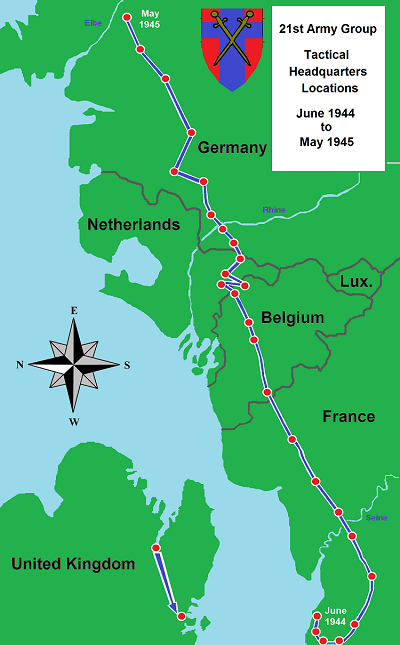
The 21st Army Group did not have a fixed
composition. Initially it included the British 2nd Army and the United
States 1st Army. The 1st Canadian Army came under command in Normandy while
1st U.S. Army reverted to U.S. control when their own army group
headquarters was formed
under General Bradley. The U.S. 9th Army was also added to the operational
control of 21 Army Group during the Ardennes fighting and retained until
after the Rhine crossing.
Britain formed seven armies in all theatres
during the war, only one operated in Northwest Europe. (The others were the
1st, 8th, 9th, 10th, 12th and 14th, which served respectively in North
Africa, the Mediterranean, Middle East, Iraq, Burma, and the Far East). Like
army groups, armies did not have fixed compositions and were composed of two
or more corps, plus “army troops” such as artillery and engineer assets. A
corps was likewise a grouping of divisions, as well as “corps troops”. Army
and corps troops could also include infantry and armoured brigades
independent of divisional attachments.
Additionally, other elements variously came
under direct command, including units of the 1st Allied Airborne Army during
Operation MARKET-GARDEN for example, or the units besieging the German
coastal garrisons after the front passed into Belgium.
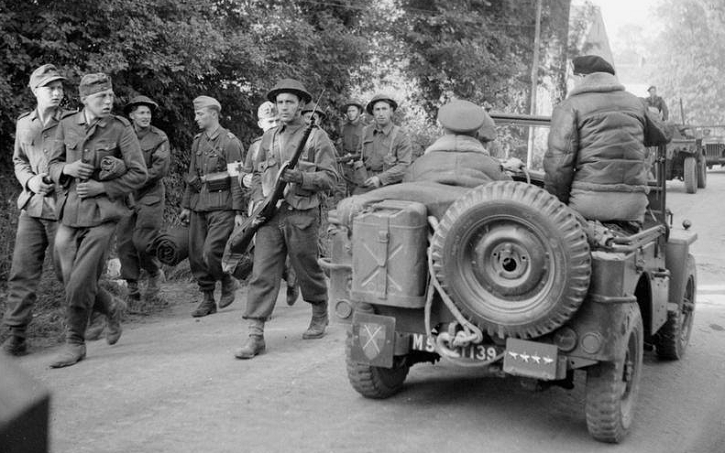
German prisoners of war do a double-take as the famous commander of 21st
Army Group, General Bernard L. Montgomery, passes them on a narrow road in
Normandy. The 1/4 ton truck ("Jeep") bears a red plate with four silver
stars, the U.S. insignia for a General. The 21st Army Group formation patch
has been applied to a metal plate attached to the left bumperette.




