|
History |
|
Wars & Campaigns |
|
►Boer
War
►First
World War
►►Western
Front
►►►Trench
Warfare: 1914-1916
►►►Allied
Offensive: 1916
►►►Allied
Offensives: 1917
►►►German
Offensive: 1918
►►►Advance
to Victory: 1918
►►Siberia
►Second
World War
►►War
Against Japan
►►North
Africa
►►Italian
Campaign
►►►Sicily
►►►Southern
Italy
►►►The
Sangro and Moro
►►►Battles
of the FSSF
►►►Cassino
►►►Liri
Valley
►►►Advance
to Florence
►►►Gothic
Line
►►►Winter
Lines
►►North-West
Europe
►►►Normandy
►►►Southern
France
►►►Channel
Ports
►►►Scheldt
►►►Nijmegen
Salient
►►►Rhineland
►►►Final
Phase
►Korean
War
►Cold
War
►Gulf
War |
|
Operations |
|
|
|
Battle Honours |
|
Boer War
First World War
Western Front
Trench Warfare: 1914-1916
Allied Offensive: 1916
|
►Somme, 1916 |
1
Jul-18 Nov 16 |
|
►Albert |
.1-13
Jul 16 |
|
►Bazentin |
.14-17
Jul 16 |
|
►Pozieres |
.23
Jul-3 Sep 16 |
|
►Guillemont |
.3-6
Sep 16 |
|
►Ginchy |
.9
Sep 16 |
|
►Flers-Courcelette |
15-22
Sep 16 |
|
►Thiepval |
26-29
Sep 16 |
|
►Le Transloy |
.
1-18 Oct 16 |
Allied
Offensives: 1917
|
►Arras 1917 |
8
Apr-4 May 17 |
|
►Vimy, 1917 |
.9-14
Apr 17 |
|
►Arleux |
28-29 Apr 17 |
|
►Scarpe, 1917 |
.3-4
May17 |
|
►Hill 70 |
.15-25
Aug 17 |
|
►Messines, 1917 |
.7-14
Jun 17 |
|
►Ypres, 1917 |
..31
Jul-10 Nov 17 |
|
►Pilckem |
31
Jul-2 Aug 17 |
|
►Langemarck, 1917 |
.16-18
Aug 17 |
|
►Menin Road |
.20-25
Sep 17 |
|
►Polygon Wood |
26
Sep-3 Oct 17 |
|
►Broodseinde |
.4
Oct 17 |
|
►Poelcapelle |
.9
Oct 17 |
|
►Passchendaele |
.12
Oct 17 |
|
►Cambrai, 1917 |
20
Nov-3 Dec 17 |
German Offensive: 1918
|
►Somme, 1918 |
.21
Mar-5 Apr 18 |
|
►St. Quentin |
.21-23
Mar 18 |
|
►Bapaume, 1918 |
.24-25
Mar 18 |
|
►Rosieres |
.26-27
Mar 18 |
|
►Avre |
.4
Apr 18 |
|
►Lys |
.9-29
Apr 18 |
|
►Estaires |
.9-11
Apr 18 |
|
►Messines, 1918 |
.10-11
Apr 18 |
|
►Bailleul |
.13-15
Apr 18 |
|
►Kemmel |
.17-19
Apr 18 |
Advance to Victory: 1918
|
►Arras, 1918 |
.26
Aug-3 Sep 18 |
|
►Scarpe, 1918 |
26-30 Aug 18. |
|
►Drocourt-Queant |
.2-3
Sep 18 |
|
►Hindenburg Line |
.12
Sep-9 Oct 18 |
|
►Canal du Nord |
.27
Sep-2 Oct 18 |
|
►St. Quentin Canal |
.29
Sep-2 Oct 18 |
|
►Epehy |
3-5
Oct 18 |
|
►Cambrai, 1918 |
.8-9
Oct 18 |
|
►Valenciennes |
.1-2
Nov 18 |
|
►Sambre |
.4
Nov 18 |
|
►Pursuit to Mons |
.28 Sep-11Nov |
Second World War
War Against Japan
South-East Asia
Italian Campaign
Battle of Sicily
Southern
Italy
The Sangro and Moro
Battles of the FSSF
|
►Anzio |
22
Jan-22 May 44 |
|
►Rome |
.22
May-4 Jun 44 |
|
►Advance
|
.22
May-22 Jun 44 |
|
to the Tiber |
. |
|
►Monte Arrestino |
25
May 44 |
|
►Rocca Massima |
27
May 44 |
|
►Colle Ferro |
2
Jun 44 |
Cassino
|
►Cassino II |
11-18
May 44 |
|
►Gustav Line |
11-18
May 44 |
|
►Sant' Angelo in
|
13
May 44 |
|
Teodice |
. |
|
►Pignataro |
14-15 May 44 |
Liri Valley
|
►Hitler Line |
18-24 May 44 |
|
►Melfa Crossing |
24-25 May 44 |
|
►Torrice Crossroads |
30
May 44 |
Advance to Florence
Gothic Line
|
►Gothic Line |
25 Aug-22 Sep 44 |
|
►Monteciccardo |
27-28 Aug 44 |
|
►Point 204 (Pozzo Alto) |
31 Aug 44 |
|
►Borgo Santa Maria |
1 Sep 44 |
|
►Tomba di Pesaro |
1-2 Sep 44 |
Winter Lines
|
►Rimini Line |
14-21 Sep 44 |
|
►San Martino- |
14-18 Sep 44 |
|
San Lorenzo |
. |
|
►San Fortunato |
18-20 Sep 44 |
|
►Sant' Angelo |
11-15 Sep 44 |
|
in Salute |
. |
|
►Bulgaria Village |
13-14 Sep 44 |
|
►Pisciatello |
16-19 Sep 44 |
|
►Savio Bridgehead |
20-23
Sep 44 |
|
►Monte La Pieve |
13-19
Oct 44 |
|
►Monte Spaduro |
19-24 Oct 44 |
|
►Monte San Bartolo |
11-14
Nov 44 |
|
►Lamone Crossing |
2-13
Dec 44 |
|
►Capture of Ravenna |
3-4
Dec 44 |
|
►Naviglio Canal |
12-15 Dec 44 |
|
►Fosso Vecchio |
16-18 Dec 44 |
|
►Fosso Munio |
19-21 Dec 44 |
|
►Conventello- |
2-6 Jan 45 |
|
Comacchio |
. |
Northwest Europe
Battle of Normandy
|
►Quesnay Road |
10-11 Aug 44 |
|
►St. Lambert-sur- |
19-22 Aug 44 |
Southern France
Channel Ports
The Scheldt
Nijmegen Salient
Rhineland
|
►The
Reichswald |
8-13 Feb 45 |
|
►Waal
Flats |
8-15 Feb 45 |
|
►Moyland
Wood |
14-21 Feb 45 |
|
►Goch-Calcar
Road |
19-21 Feb 45 |
|
►The
Hochwald |
26
Feb- |
| . |
4
Mar 45 |
|
►Veen |
6-10 Mar 45 |
|
►Xanten |
8-9
Mar 45 |
Final Phase
|
►The
Rhine |
23
Mar-1 Apr 45 |
|
►Emmerich-Hoch
|
28
Mar-1 Apr 45 |
|
Elten |
. |
Korean War
|
|
Domestic Missions |
|
►FLQ
Crisis |
|
International
Missions |
|
►ICCS
Vietnam 1973
►MFO
Sinai 1986- |
|
Peacekeeping |
|
►UNTEA |
W. N. Guinea 1963-1964 |
|
►ONUCA |
C. America
1989-1992 |
|
►UNTAC |
Cambodia
1992-1993 |
|
►UNMOP |
Prevlaka
1996-2001 |
|
|
Exercises |
|
The War Against Japan
|
Canada and the United
States both committed to a policy of "Germany First" in the Second
World War; however, The War Against Japan was also a vital national
interest, and Canadians participated in combat operations in the
Pacific from 1941 to 1945. The war against Japan also had far reaching
political implications in Canada, as the Government chose to imprison
Canadian citizens of Japanese descent based solely on their racial
characteristics. |
 |
Hong Kong
See also article on
Hong Kong
Upon the request of the British Government,
Canada agreed to send an under-strength brigade to garrison Hong Kong,
therefore freeing up troops for other British possessions in the Far East.
Canada sent 1,975 soldiers (including two Auxiliary Services supervisors)
from The Royal Rifles of Canada and The Winnipeg Grenadiers. After the
Japanese invasion on 8 December 1941, the small force was divided and sent
into combat - the island held out until Christmas. Those men not killed in
the fighting were captured, many dying of mistreatment in captivity.
Company Sergeant Major John Osborne of the Grenadiers was awarded a
posthumous Victoria Cross for his actions during the fighting.


At left, Allied
prisoners-of-war awaiting liberation by the landing party from HMCS
Prince Robert, Hong Kong, ca. 30 Aug 1945. LAC Photo.
At right, "C" Company of
The Royal Rifles of Canada disembarks at Hong Kong on 16 Nov 1941. LAC
Photo.
Background
While Japan had been an
ally of Britain in the First World War, their alliance ended in 1922.
Increasing Japanese militarism in the 1930s began
to pose a threat to British overseas possessions, including Japanese occupation of Canton
in 1938. While some studies of the
problem of defending Hong Kong from attack had concluded that a defence of
the island was impossible, a defensive position on the mainland had been
begun in the 1930s. By 1940, a decision had been made to keep a limited
garrison on the island.
The British Government
called on Canada to assist in the defence of Hong Kong in September 1941. Canada
at that time had three divisions and a tank brigade in the United Kingdom,
with another division preparing to move to the UK in short order. The British felt that a
reinforcement of the garrison at Hong Kong was justified, in order to
reassure the Chinese that the Allies had a genuine intention to hold the
colony, and as a boost to morale throughout the Far East. Canada agreed to
send two battalions. Upon request for a brigade headquarters and other
specialists such as signallers, Canada agreed to this as well.
-
It will be noted that neither in
Ottawa nor in London (from which Ottawa derived most of its intelligence
on such matters) was there at this time any apprehension of immediate
war in the Pacific.1
The Winnipeg Grenadiers, recently returned from garrison duty in
Jamaica, and The Royal Rifles of Canada, recently returned from garrison
duty in Newfoundland, were sent to the island under Brigadier J.K. Lawson.
A force of 1,975 Canadians eventually sailed from Vancouver on 27
October and landed at
Hong Kong on 16 November 1941.
The Japanese Attack
A Japanese attack on Hong
Kong began shortly after 0800 on 8 December 1941 (local time), less than
eight hours after the attack on Pearl Harbor. Allied forces commanded by
Major-General Maltby, supported by the local Militia (Hong Kong Volunteer
Defence Forces), were hard pressed by the Japanese 38th Division as they
were outnumbered two to one and lacked the recent combat experience that
the Japanese had.
The Japanese achieved air
superiority on 8 December and resistance on
the mainland was quickly overcome; the Sham Chun River was forded by the
Japanese using temporary bridges. Three battalions emplace in a defensive
position known as the Gin Drinkers' Line were breached early on 10
December 1941. The mainland force withdrew to the island on the 11th under
aerial and artillery bombardment. The last British soldiers had left the
mainland on 13 December.

- Defending the Island
The forces on the mainland
were organized into a West Brigade and an East Brigade, and the Canadian
battalions split between the two. Bombardment of the north shore of
the island by the Japanese began on 15 December. Two demands for surrender
of the island were rejected, and landings on the north-east shore were
effected by the Japanese on the evening of 18 December with light losses.
The first Canadians to see
action were "C" Company of the Royal Rifles who delivered an unsuccessful counter-attack
on the landing areas. Other companies attempted
to drive the enemy from Mount Parker but were similarly unsuccessful. The
East Brigade, to whom the Rifles belonged, were ordered to withdraw the
next morning, towards Stanley Peninsula. It was recognized that scattered
actions were accomplishing little
and it was hoped to concentrate the force. By the time the brigade had reached positions at Stanley
Mound, the Royal Rifles and some companies of the Volunteer Defence Corps
were all that was left; the 5th/7th Rajput and brigade artillery had been
lost.
In the west, three platoons
of the Winnipeg Grenadiers had been organized as "flying columns" designed
to swiftly counter-attack where needed. All three platoons went into
action on the night of 18-19 December. Two saw combat at Jardine's Lookout
and Mount Butler where they were repulsed. Early on the morning of the 19th, "A" Company
was sent forward to Jardine's Lookout, ordered to engage
the enemy there and keep going to Mount Butler. The company was surrounded
and outnumbered, and only a handful escaped death, injury or capture.
Every officer was killed or severely wounded. The Company Sergeant Major,
John Osborne, was awarded the
Victoria Cross posthumously for actions in the fighting on Mount
Butler.
By 10:00, the Japanese
overran the West Brigade headquarters at Wong Nei Chong Gap, and Brigadier
Lawson was killed. "D" Company of the
Grenadiers held their position in the gap for nearly three more days,
denying the Japanese the use of a main north-south road and killing
approximately 200 Japanese soldiers. A series of uncoordinated attacks by
the other companies of the Grenadiers and a battalion of the Royal Scots
failed to relieve "D" Company.
- Final Battles
The Royal Rifles of Canada
had little sleep and no hot food in the days leading to the Japanese
attack. Nonetheless, attempts were made to counter-attack to the north and
link up with forces of the West Brigade. An attempt on 20 December to
skirt Repulse Bay and contact the other brigade at Wong Nei Chong Gap was
stopped after the Repulse Bay Hotel was taken. One company of the Rifles
was left in place to hold the hotel and thereby isolated. Another attack
was made the next day, also running into heavy Japanese opposition.
Attacks on Japanese forces on high ground around the Tai Tam Tuk Reservoir
managed to defeat some Japanese forces and drive them from their
positions, but a Japanese counter-attack by tanks stalled any further
advance.
On the evening of the 21st,
the company of Rifles at the hotel managed to move north and contact a
group of British soldiers only a few hundred yards from the Wong Nei Chong
Gap, holding the position until 22 December. After dark on 22 December,
this group withdrew to the hotel, which was ordered evacuated during the
night. Approximately a platoon of soldiers managed to slip through the
enemy's positions and rejoin the main force at Stanley. The 22nd and 23rd
saw constant attacks by the Japanese, and consequently, no further efforts
to break out to the north. Sugar Loaf Hill fell to the Japanese on the
22nd and was retaken by the Rifles on the 23rd. Another company lost
Stanley Mound, and it could not be retaken. By the late afternoon of 23
December the entire force pulled back further onto the Stanley Peninsula.
On the 24th the Royal Rifles were taken out of the line for a rest, and
hurriedly thrown back in on the 25th. "D" Company made a counter-attack on
the Stanley Prison in the early afternoon and were stopped with heavy
losses. Evening brought news of the surrender.
In the west, the Winnpeg
Grenadiers occupied Mount Cameron on the morning of 21 December, and
followed their orders to hold it in the face of dive-bombing and mortaring
until a night attack by the Japanese on the night of 22-23 December. The
goal of the West Brigade was to hold a continuous line from Victoria
Harbour to the south shore. On 23 December, the line was still holding;
the left was held by remanant of a battalion of the Middlesex Regiment on
Leighton Hill, two Indian battalions, the Royal Scots who stabilized the
line on the western slopes of Mount Cameron, and the Winnipeg Grenadiers
on the right holding the line from Cameron to Bennet's Hill. The 24th saw
Leighton's Hill fall, and later portions of the Mount Cameron defences.
The Grenadiers also lost ground at Bennet's Hill while standing firm on
the south slopes of Mount Cameron, and counter-attacks on the 25th
regained some of the positions lost on Bennet's Hill before word of the
surrender came.
- Climax
On the afternoon of 25
December 1941, the Governor of Hong Kong officially surrendered to the
Japanese, ending 18 days of fighting and marking the first occasion on
which a British Crown Colony had to surrender to an invader.
Aftermath
The island fell under
Japanese occupation for three years and eight months. Looting and rape of
the civil population by Japanese soldiers was common. The Canadians lost
23 officers and 267 other ranks killed, died of wounds, or murdered in the
fighting. The survivors were captured to the last man, and remained in
prison camps on Hong Kong until 1943. Four officers and 125
other ranks died in these camps in poor conditions (four of them shot
without trial after escaping). In Jan 1943, 1 officer and 1,183 other
ranks of the remaining survivors were sent to Japan, and lived in equally
bad conditions where a further 135 men died. In total, 555 of the 1,975
man contingent had died before the end of the war.
Battle Honours
The following units were
awarded the Battle Honour "Hong Kong":
The Aleutians
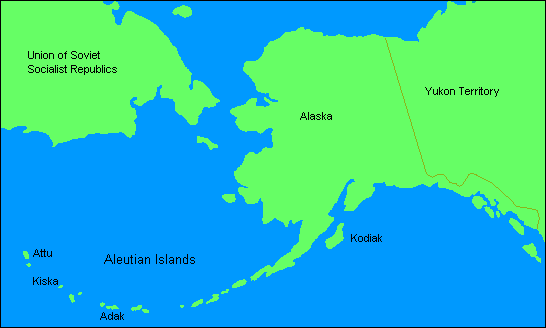
Canada also sent 5,300
troops of the 13th Canadian Brigade Group to participate in military
operations in the Aleutians Campaign in 1943. The invasion on 7 August
1943 also included the Canadian-American First Special Service Force. The
objective was to reclaim the islands of Kiska and Attu from the Japanese,
and the force saw no combat there as the Japanese had withdrawn on 28 July
1943, prior to the Allied landings. The battle was significant in that
large numbers of conscripts had been included in the brigade.
Other Military Activities
Canada remained active in
the Pacific theatre until the end of the war on 2 September 1945.
Individual augmentees to Commonwealth forces served in various roles,
including Canadian signallers in Australia, sailors with the British
Pacific Fleet, RCAF airmen in Burma, and naval aviators with the Fleet Air
Arm. Chinese-Canadian soldiers were recruited for service in occupied
Malaya as spies and trainers of local guerrillas.
The Invasion of Japan
At the time of the
armistice with Japan, the Canadian Army Pacific Force was in training to
take part in the proposed invasion of the mainland, entitled Operation
DOWNFALL. Canadian ships in the British Pacific Fleet and bomber squadrons
had also been transferred from Europe with Tiger Force and were also
training for their participation. The planned invasion of Kyushu,
Operation OLYMPIC, was cancelled after Japan's surrender following the
Atomic bombings of Hiroshima and Nagasaki and the Soviet declaration of
war on Japan.
Notes
-
Stacey, C.P. The Canadian Army 1939-1945: An Official
Historical Summary (King's Printer, Ottawa, ON, 1948)
p.274
|

