|
History |
|
Wars & Campaigns |
|
►Boer
War
►First
World War
►►Western
Front
►►►Trench
Warfare: 1914-1916
►►►Allied
Offensive: 1916
►►►Allied
Offensives: 1917
►►►German
Offensive: 1918
►►►Advance
to Victory: 1918
►►Siberia
►Second
World War
►►War
Against Japan
►►North
Africa
►►Italian
Campaign
►►►Sicily
►►►Southern
Italy
►►►The
Sangro and Moro
►►►Battles
of the FSSF
►►►Cassino
►►►Liri
Valley
►►►Advance
to Florence
►►►Gothic
Line
►►►Winter
Lines
►►North-West
Europe
►►►Normandy
►►►Southern
France
►►►Channel
Ports
►►►Scheldt
►►►Nijmegen
Salient
►►►Rhineland
►►►Final
Phase
►Korean
War
►Cold
War
►Gulf
War |
|
Operations |
|
|
|
Battle Honours |
|
Boer War
First World War
Western Front
Trench Warfare: 1914-1916
Allied Offensive: 1916
|
►Somme, 1916 |
1
Jul-18 Nov 16 |
|
►Albert |
.1-13
Jul 16 |
|
►Bazentin |
.14-17
Jul 16 |
|
►Pozieres |
.23
Jul-3 Sep 16 |
|
►Guillemont |
.3-6
Sep 16 |
|
►Ginchy |
.9
Sep 16 |
|
►Flers-Courcelette |
15-22
Sep 16 |
|
►Thiepval |
26-29
Sep 16 |
|
►Le Transloy |
.
1-18 Oct 16 |
Allied
Offensives: 1917
|
►Arras 1917 |
8
Apr-4 May 17 |
|
►Vimy, 1917 |
.9-14
Apr 17 |
|
►Arleux |
28-29 Apr 17 |
|
►Scarpe, 1917 |
.3-4
May17 |
|
►Hill 70 |
.15-25
Aug 17 |
|
►Messines, 1917 |
.7-14
Jun 17 |
|
►Ypres, 1917 |
..31
Jul-10 Nov 17 |
|
►Pilckem |
31
Jul-2 Aug 17 |
|
►Langemarck, 1917 |
.16-18
Aug 17 |
|
►Menin Road |
.20-25
Sep 17 |
|
►Polygon Wood |
26
Sep-3 Oct 17 |
|
►Broodseinde |
.4
Oct 17 |
|
►Poelcapelle |
.9
Oct 17 |
|
►Passchendaele |
.12
Oct 17 |
|
►Cambrai, 1917 |
20
Nov-3 Dec 17 |
German Offensive: 1918
|
►Somme, 1918 |
.21
Mar-5 Apr 18 |
|
►St. Quentin |
.21-23
Mar 18 |
|
►Bapaume, 1918 |
.24-25
Mar 18 |
|
►Rosieres |
.26-27
Mar 18 |
|
►Avre |
.4
Apr 18 |
|
►Lys |
.9-29
Apr 18 |
|
►Estaires |
.9-11
Apr 18 |
|
►Messines, 1918 |
.10-11
Apr 18 |
|
►Bailleul |
.13-15
Apr 18 |
|
►Kemmel |
.17-19
Apr 18 |
Advance to Victory: 1918
|
►Arras, 1918 |
.26
Aug-3 Sep 18 |
|
►Scarpe, 1918 |
26-30 Aug 18. |
|
►Drocourt-Queant |
.2-3
Sep 18 |
|
►Hindenburg Line |
.12
Sep-9 Oct 18 |
|
►Canal du Nord |
.27
Sep-2 Oct 18 |
|
►St. Quentin Canal |
.29
Sep-2 Oct 18 |
|
►Epehy |
3-5
Oct 18 |
|
►Cambrai, 1918 |
.8-9
Oct 18 |
|
►Valenciennes |
.1-2
Nov 18 |
|
►Sambre |
.4
Nov 18 |
|
►Pursuit to Mons |
.28 Sep-11Nov |
Second World War
War Against Japan
South-East Asia
Italian Campaign
Battle of Sicily
Southern
Italy
The Sangro and Moro
Battles of the FSSF
|
►Anzio |
22
Jan-22 May 44 |
|
►Rome |
.22
May-4 Jun 44 |
|
►Advance
|
.22
May-22 Jun 44 |
|
to the Tiber |
. |
|
►Monte Arrestino |
25
May 44 |
|
►Rocca Massima |
27
May 44 |
|
►Colle Ferro |
2
Jun 44 |
Cassino
|
►Cassino II |
11-18
May 44 |
|
►Gustav Line |
11-18
May 44 |
|
►Sant' Angelo in
|
13
May 44 |
|
Teodice |
. |
|
►Pignataro |
14-15 May 44 |
Liri Valley
|
►Hitler Line |
18-24 May 44 |
|
►Melfa Crossing |
24-25 May 44 |
|
►Torrice Crossroads |
30
May 44 |
Advance to Florence
Gothic Line
|
►Gothic Line |
25 Aug-22 Sep 44 |
|
►Monteciccardo |
27-28 Aug 44 |
|
►Point 204 (Pozzo Alto) |
31 Aug 44 |
|
►Borgo Santa Maria |
1 Sep 44 |
|
►Tomba di Pesaro |
1-2 Sep 44 |
Winter Lines
|
►Rimini Line |
14-21 Sep 44 |
|
►San Martino- |
14-18 Sep 44 |
|
San Lorenzo |
. |
|
►San Fortunato |
18-20 Sep 44 |
|
►Sant' Angelo |
11-15 Sep 44 |
|
in Salute |
. |
|
►Bulgaria Village |
13-14 Sep 44 |
|
►Pisciatello |
16-19 Sep 44 |
|
►Savio Bridgehead |
20-23
Sep 44 |
|
►Monte La Pieve |
13-19
Oct 44 |
|
►Monte Spaduro |
19-24 Oct 44 |
|
►Monte San Bartolo |
11-14
Nov 44 |
|
►Lamone Crossing |
2-13
Dec 44 |
|
►Capture of Ravenna |
3-4
Dec 44 |
|
►Naviglio Canal |
12-15 Dec 44 |
|
►Fosso Vecchio |
16-18 Dec 44 |
|
►Fosso Munio |
19-21 Dec 44 |
|
►Conventello- |
2-6 Jan 45 |
|
Comacchio |
. |
Northwest Europe
Battle of Normandy
|
►Quesnay Road |
10-11 Aug 44 |
|
►St. Lambert-sur- |
19-22 Aug 44 |
Southern France
Channel Ports
The Scheldt
Nijmegen Salient
Rhineland
|
►The
Reichswald |
8-13 Feb 45 |
|
►Waal
Flats |
8-15 Feb 45 |
|
►Moyland
Wood |
14-21 Feb 45 |
|
►Goch-Calcar
Road |
19-21 Feb 45 |
|
►The
Hochwald |
26
Feb- |
| . |
4
Mar 45 |
|
►Veen |
6-10 Mar 45 |
|
►Xanten |
8-9
Mar 45 |
Final Phase
|
►The
Rhine |
23
Mar-1 Apr 45 |
|
►Emmerich-Hoch
|
28
Mar-1 Apr 45 |
|
Elten |
. |
Korean War
|
|
Domestic Missions |
|
►FLQ
Crisis |
|
International
Missions |
|
►ICCS
Vietnam 1973
►MFO
Sinai 1986- |
|
Peacekeeping |
|
►UNTEA |
W. N. Guinea 1963-1964 |
|
►ONUCA |
C. America
1989-1992 |
|
►UNTAC |
Cambodia
1992-1993 |
|
►UNMOP |
Prevlaka
1996-2001 |
|
|
Exercises |
|
Battle of the Rhineland
|
The Battle of the
Rhineland was fought in Feb-Mar 1945 between Allied forces from
Canada, the United Kingdom, and the United States (as well as smaller
national contingents), and the German forces occupying territory south
and west of the Rhine River during the North-West Europe campaign of
the Second World War.
Situation
In early 1945, after a
long winter stalemate, military operations by the Allied armies in
North-West Europe resumed. The exertions of the First Canadian Army in
the Battle of the Scheldt had resulted in the port of Antwerp being
opened in late 1944. A build up of Allied forces on the western front,
as Southern France was cleared of German soldiers and the other Allies
advanced to the German frontier, "laid the foundation for a further
offensive on the western front. The enemy's costly effort in the
Ardennes and imposed delay, but the broad pattern of Allied strategy
remained unchanged."1
The Battle of the
Rhineland would be the first of three major strategic phases envisaged
by General Eisenhower:
-
In planning our
forthcoming spring and summer offensives, I envisaged the operations
which would lead to Germany's collapse as falling into three phases:
first, the destruction of the enemy forces west of the Rhine and
closing to that river; second, the seizure of bridgeheads over the
Rhine from which to develop operations into Germany; and third, the
destruction of the remaining enemy east of the Rhine and the advance
into the heart of the Reich. This was the same purpose that had
guided all our actions since early 1944.2
The initial goal was to
reach the Rhine River, the last significant natural barrier between
Allied forces and Germany. From their winter positions in the Nijmegen
Salient, the First Canadian Army reinforced by elements of the British
2nd Army, began operations to advance south east, clearing all land
west of the river. Operation VERITABLE was a costly advance through
flooded terrain and German defensive lines, followed by Operation
BLOCKBUSTER which succeeded in driving through almost to the banks of
the Rhine River. Operation BLOCKBUSTER II cleared the town of
Xanten to end the fighting in the Rhineland. A supporting
operation by the US 9th Army, Operation GRENADE, was planned to
coincide from the River Roer to the south but was delayed for two
weeks by German flooding of the Roer valley. |
|
|
The Rhineland battle
was intended to be a prelude to a set-piece crossing of the Rhine by
the 21st Army Group. While this operation did proceed in late Mar
1945, American forces managed to cross the river in other locations
with less preparation, including the capture of an intact bridge at
Remagen on 7 Mar 1945 by the US 1st Army, and a crossing by the US 3rd
Army the day before the British crossing, Operation PLUNDER. PLUNDER
was supported by Operation VARSITY, a large airborne drop on the far
side of the Rhine in which the 1st Canadian Parachute Battalion played
an active part. The Rhine crossings and battles afterward comprised
the Final Phase of the war in Europe.
The Battle Honour "The
Rhineland" refers only to actions fought west of the river, while the
Battle Honour "The Rhine" was awarded to units fighting in the
crossing itself as well as on the east bank during the Final Phase.
|
 |
| Awaiting the final
clearing of the Rhineland on 4 Mar 1945 at Kranenburg, Germany. From
left to right General H.D.G. Crerar GOC-i-C First Canadian Army,
Lieutenant General G.G. Simonds GOC II Canadian Corps, Field Marshal
Sir Alan Brooke (CiGS), Prime Minister Winston Churchill, and at far
right Field Marshal B.L. Montgomery GOC-i-C 21st Army Group |
The Battle
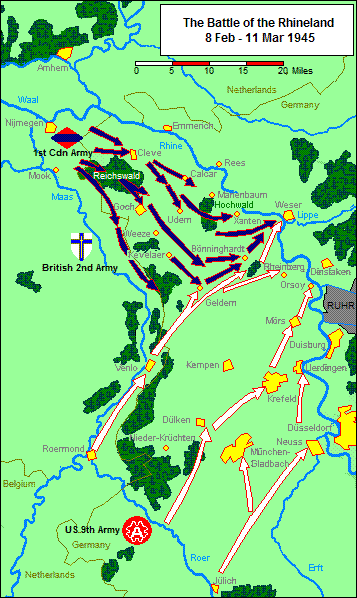 The
terrain in the Rhineland was marked by clear boundaries, bordered on one
side by the Rhine and the other by the Maas, measuring about 50 kilometres
long by from 20 to 30 kilometres wide, widening as one moved further from
the Allied start line. The first third, from the Allied viewpoint, was
flooded and the other two were covered in thick mud due to winter rains.
Much of the ground was marked by thick forests, and there were no
noticably high or low features. Engagement ranges were short. Defences
were well prepared, as the enemy had four months to improve positions,
including some of the pre-war Siegfried Line obstacles. The Germans built
strong points and hedgehogs - positions for all-around defence against
attack from any direction. All these factors "made for a very complex
battle, extremely difficult for higher headquarters to 'read' on an
hour-by-hour basis, and the brunt of the decision-making seems to have
fallen on the two corps commanders, Sir Brian Horrocks (British XXX Corps)
and (Lieutenant General Guy) Simonds (II Canadian Corps)."3 The
terrain in the Rhineland was marked by clear boundaries, bordered on one
side by the Rhine and the other by the Maas, measuring about 50 kilometres
long by from 20 to 30 kilometres wide, widening as one moved further from
the Allied start line. The first third, from the Allied viewpoint, was
flooded and the other two were covered in thick mud due to winter rains.
Much of the ground was marked by thick forests, and there were no
noticably high or low features. Engagement ranges were short. Defences
were well prepared, as the enemy had four months to improve positions,
including some of the pre-war Siegfried Line obstacles. The Germans built
strong points and hedgehogs - positions for all-around defence against
attack from any direction. All these factors "made for a very complex
battle, extremely difficult for higher headquarters to 'read' on an
hour-by-hour basis, and the brunt of the decision-making seems to have
fallen on the two corps commanders, Sir Brian Horrocks (British XXX Corps)
and (Lieutenant General Guy) Simonds (II Canadian Corps)."3
The initial attack on 8 Feb
1945 (Operation
VERITABLE) was launched by three British divisions and the 3rd
Canadian Infantry Division on the flooded left flank over the Waal Flats.
The ancient city of Cleve was bombed flat, and the heaviest artillery
bombardment of the entire war was laid on. The Materborn Gap was
considered the key to the advance; 3,000 metres of open ground stretching
between Cleve and the trees of The Reichswald to the south. The British
made it through on 11 Feb after three costly days of fighting through the
woods. The 3rd Division, making use of amphibious vehicles, had a slightly
easier time and many opted to withdraw as the British advances threatened
to cut them off.
As the British advance
slackened, the 2nd Canadian Infantry Division moved up, and both divisions
now had as their objective the Goch-Calcar Road, which would be the Start
Line for the second phase of the Rhineland fighting, Operation
BLOCKBUSTER. The line was cleared at great cost; one of the fallen,
Sergeant Aubrey Cosens of The Queen's Own Rifles of Canada, was awarded a
posthumous Victoria Cross.
- The Germans practised their
traditional tactics of giving ground under pressure but then immediately
launching counter-attacks to recover the lost ground before the
Canadians could consolidate their successes. When that happened,
infantry companies which had been badly weakened in the initial assault
were often cut off and assailed from all sides. The ultimate response
was to call down artillery fire on their own
positions...Veritable...(cost) the British nearly seven thousand
casualties and the Canadians nearly two thousand - a ratio roughly
proportionate to their respective commitments - while the Germans lost
about twelve thousand killed, the same number taken prisoner, and
perhaps another twenty thousand wounded.4
For the second phase, BLOCKBUSTER, the 4th
Canadian (Armoured) Division replaced the 3rd in the line. To the south,
the American 9th Army was also advancing to the Rhine in Operation
GRENADE, delayed until 23 Feb due to the German destruction of two key
dams on the Roer River and consequent heavy flooding making the area
impassable. They found, once they were moving north towards the British
and Canadians, that most of the Germans had been moved away to oppose
VERITABLE. The Germans were desperate to hold out at long as possible west
of the Rhine as at least 17 divisions were streaming to the bridges at
Wesel, now only 15 kilometres from the Canadians and 20 from the
Americans.
The 2nd and 4th Canadian
Divisions now advanced roughly abreast into more heavy forest; The
Hochwald, Tüschenwald and Bambergerwald, running along a low ridge and
with positions improved by the Germans for the previous two weeks. The 2nd
Division went straight into the Hochwald while the 4th Division aimed for
a narrow gap in the woods. Two attacks went in, and it was made apparent
an armoured division was not able to simply blast through; the Germans had
a wide variety of close-range anti-tank weaponry, the tanks had trouble
negotiating the mud, and the Canadians didn't have enough infantry to
clear a path for the tanks. The battle for the Hochwald Gap lasted from 27
Feb to 3 Mar and advances were measured in hundreds of yards. The 3rd
Division returned to the line and the 2nd Division sent a brigade to
assist in opening the gap. The other two brigades of the 2nd Division kept
pressure on the Germans elsewhere on the line. Captain Frederick Tilston
of The Essex Scottish was awarded a Victoria Cross for his actions in one
of the many small unit actions.
By the second week of Mar,
the Germans had fallen back to the Wesel Pocket, and final actions at
Veen and
Xanten had cleared the final defenders away by the 10th. A hastily
organized operation to "bounce" the Rhine was scrubbed when the sound of
German demolitions announced that the last bridges over the River had been
blown up.
Casualties
The fight to advance 20
miles into the Rhineland and clear the remaining German units west of the
great river took as long - one month - as the 200 mile advance that would
follow it. The cost in terms of casualties was also higher; 9,284 American
soldiers and 17,685 British and Canadian soldiers became casualties.5
First Canadian Army took 22,000 German prisoners and killed or seriously
wounded 22,000 more. Including the losses inflicted by the US 9th Army
(which lost 7,300 men, took 29,000 prisoners, and killed or seriously
wounded 16,000 Germans during the Rhineland fighting) the Germans all told
lost 90,000 men while inflicting 23,000 Allied casualties.6
Battle Honours
The following Battle Honours were awarded
to Canadian units participating in the Battle of the Rhineland:
- The Rhineland
- The Reichswald
- Waal Flats
- Cleve
- Moyland Wood
- Goch-Calcar Road
- The Hochwald
- Veen
- Xanten
Notes
- Stacey, C.P., The Canadian Army
1939-1945: An Official Historical Summary (Queen's Printer,
Ottawa, ON, 1948), p.236
- Quoted in Stacey, Ibid, p.236
- Marteinson, John. We Stand on
Guard: An Illustrated History of the Canadian Army (Ovale Publications,
Montreal, PQ, 1992) ISBN 2894290438 p.317
- Ibid, pp.318-319
- Whitaker, Denis & Shelagh
Rhineland: The Battle to End the War (Stoddart Publishing
Company, Ltd., Toronto, ON, 1989) ISBN 0773753907 p.347. Williams (see
below for reference) gives a fiture of 15,634, broken down as 10,300
British and 5,655 Canadian.
- Williams, Jeffery The Long Left
Flank: The Hard Fought Way to the Reich, 1944-45 (Stoddart
Publishing Company, Ltd., Toronto, ON, 1988) ISBN 0773721940 p.251
|



